
The first day of something bigger
George sat in his truck outside the office at 6:47 Monday morning. He was early. Of course he was early. New job. New company. Bigger territory. Bigger expectations.
Twelve years in commercial HVAC sales had taught him plenty: how to talk to general contractors, how to listen to a superintendent, and how to recognize the difference between a promising project and a waste of everybody's time. He knew how to do this job. That's why they'd hired him. But being good at something and proving it to a new boss were two very different things.
His phone lit up. His wife had sent a picture of their daughter holding up a crooked handmade sign: Good luck, Dad! George laughed quietly. He'd taken this job for a reason—the chance to grow, maybe lead a region someday, and give his family a little more breathing room. He turned off the engine and headed inside.
Fourteen browser tabs
By Wednesday afternoon, George had fourteen browser tabs open. City permits. Construction announcements. Planning agendas. Contractor directories. Pages that loaded slowly and reports that seemed to lead nowhere.
He'd found projects, all right. One was already awarded. Two were outside his territory. Another looked promising until he found the date. Between onboarding meetings and introductions to the estimating team, he'd spent hours hunting for projects and very little time developing them.
His new boss had said, 'We need a strong pipeline heading into spring.' George had nodded. He knew spring work could be shaped months before the weather changed. Now October was slipping away, and he was still trying to figure out which conversations were worth starting.
Dad? Are you working again?
At the kitchen table that night, George opened his laptop for what he'd promised himself would be ten minutes. A commercial listing was almost—but not quite—clear enough to act on. He clicked another link. Then another.
His daughter was telling him about school. George heard every third word while he tried to match an address to a project record. 'Dad?' He looked up. 'Are you working again?'
He closed the laptop. 'Not anymore, sweetheart.' She smiled and continued her story. George tried to smile too. The question stayed with him. He wasn't afraid of hard work. What bothered him was putting in so many hours without feeling any closer to a full pipeline.
A better starting point
George wasn't looking for magic. A service promising guaranteed contracts would have made him suspicious. He knew a permit wasn't a bid invitation, and a project announcement wasn't proof that a subcontract was available.
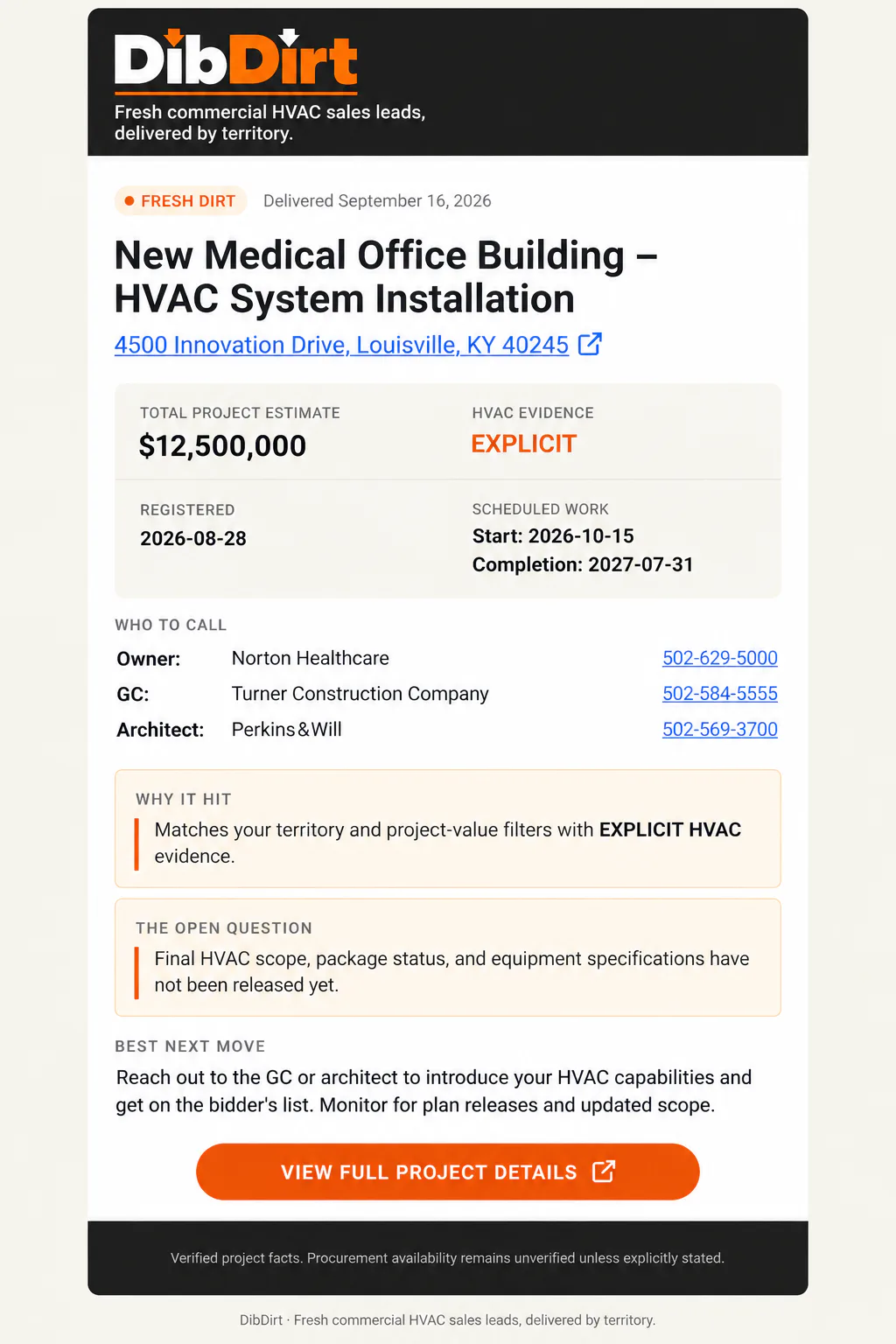
What caught his eye about DibDirt was simpler: commercial project intelligence organized by trade and territory, with public-source records that he could examine himself. Instead of beginning each morning with an empty search bar, he could start with signals worth qualifying.
He still had to call people, ask smart questions, build trust and help his team price the work. That was the part he was good at. Finding a reasonable place to begin was the part consuming his day. And that, finally, felt changeable.
Something worth bringing to the table
On Friday, George carried a short list into the meeting. Not fifty names copied from a directory. A few commercial projects in his territory, the available source information, and notes about what needed checking next.
One facility expansion deserved a call. Another appeared to involve mechanical work that might match their capabilities. A third gave George a reason to reconnect with a general contractor he knew. He didn't claim any of them were contracts. He explained why each deserved attention.
His boss leaned forward. 'Where'd you find these?' George smiled. 'Found a better way to research the market.' He was still the new guy. But he wasn't just reporting activity anymore. He was bringing a plan.
The future feels closer
In George's story, an introduction became a conversation. A conversation became a request for pricing. And an early opportunity eventually became an agreement for work the following spring. George earned it—through relationships, judgment, and a competitive proposal from his team.
DibDirt hadn't closed a deal. It had helped him discover something worth pursuing sooner. Other leads went nowhere, as leads sometimes do. But George now had a repeatable way to research what might be coming next.
That Halloween, George walked beside his daughter as she went from door to door. His phone stayed in his pocket. He wasn't thinking about fourteen browser tabs. He was thinking about next week's conversations, the pipeline taking shape, and the reason he'd taken this job in the first place.